
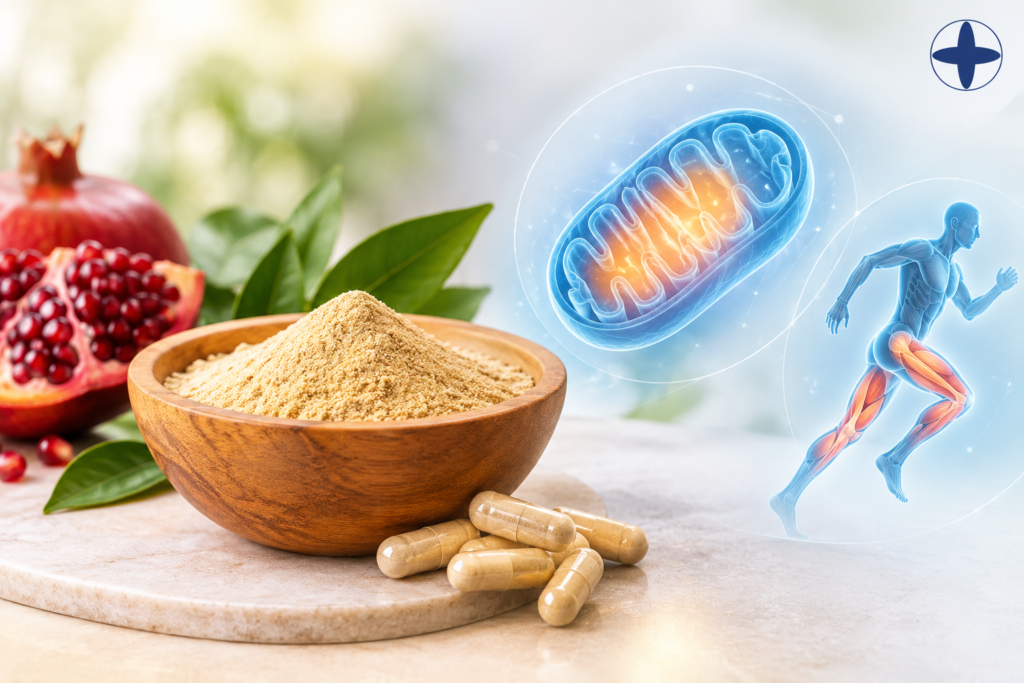
Healthy aging has become one of the fastest-moving areas in supplements, and the conversation is shifting from general wellness toward what happens inside our cells. Mitochondria, the structures that produce most of a cell’s usable energy, are now a central part of that discussion. One ingredient attracting growing interest from brands, formulators and researchers is urolithin A.
Urolithin A is a gut-derived compound studied for its role in mitochondrial renewal and its potential to support muscle endurance and strength as we age. For brands building products in healthy aging, active lifestyle and cellular energy, it is worth understanding. This guide covers what urolithin A is, what the human research reports (and where it stops), and what supplement teams should evaluate before adding it to a formula. If you’re also mapping out a broader lineup, our specialty nutraceuticals portfolio is a useful place to see what else is in the same category.
What Is Urolithin A?
Urolithin A is a metabolite, a compound the body or its microbes create while breaking down other substances. In this case, certain gut bacteria convert ellagitannins and ellagic acid, polyphenols found in pomegranates, walnuts and some berries, into urolithin A. Nobody eats urolithin A directly, because the food contains the precursors and not the finished compound.
That creates a practical problem. How much urolithin A a person produces depends on their gut microbiome, and published estimates suggest many people convert these precursors poorly or not at all. Age, diet and antibiotic exposure may all play a part. Even for people who do produce it, the amount from food is hard to predict and hard to control. A direct supplement offers a more consistent way to deliver a defined amount, which is a big reason the ingredient has drawn interest.
Because it is produced by gut microbes from dietary compounds, urolithin A is often described as a postbiotic. That puts it alongside other gut-derived ingredients that brands are exploring, such as the prebiotics we covered in our post on human milk oligosaccharides for premium prebiotic formulas.
Why Mitochondrial Health Matters
Mitochondria convert nutrients into ATP, the energy currency cells rely on. They are especially abundant in tissues with high energy demands, such as skeletal muscle, heart and brain. Over time, mitochondria can accumulate damage, and the cell’s ability to clear and replace them tends to decline with age.
This matters for muscle in particular. Muscle needs a steady, reliable energy supply to contract repeatedly, resist fatigue and recover. When mitochondrial quality declines, the effects can show up as reduced endurance and slower recovery. That is why mitochondrial function has become a focal point for product developers targeting healthy aging, active adults and people who want to stay physically capable as they get older.
How Urolithin A Works: Mitophagy in Plain Language
The mechanism most often linked to urolithin A is mitophagy, a quality-control process in which cells identify damaged or worn-out mitochondria, break them down and recycle the components. Healthy mitophagy helps make room for newer, better-functioning mitochondria.
Pre-clinical research has reported that urolithin A can stimulate mitophagy and improve muscle function in older animals. Human studies have since looked at whether similar effects show up in people, using muscle biopsies, blood biomarkers and functional tests. It is important to keep this distinction clear in your messaging: mechanistic and animal data help explain why researchers are interested, but they are not the same as proof of a consumer benefit.
What the Clinical Research Shows
The human data on urolithin A is still developing, but it is more substantial than for many emerging ingredients. Here are the main studies formulators should know.
An early study in older adults
Early human work in sedentary older adults evaluated oral urolithin A over a short period. It reported that the compound was safe and well tolerated, and that it was associated with changes in markers of mitochondrial gene expression and in plasma biomarkers. This work helped establish the safety profile and laid the groundwork for longer trials.
The 2022 trial in adults aged 65 to 90
A double-blind, placebo-controlled randomized trial published in JAMA Network Open in 2022 enrolled 66 adults aged 65 to 90. Participants took either 1,000 mg of urolithin A or placebo daily for four months. The researchers reported:
- Improved muscle endurance in hand and leg muscles compared with placebo
- Reductions in several plasma biomarkers, including acylcarnitines, ceramides and C-reactive protein, which the study associated with mitochondrial health and inflammation
- The supplement was safe and well tolerated
The same trial also reported that improvements in six-minute walk distance and in maximal ATP production in the hand muscle were not statistically significant versus placebo. The authors concluded that long-term supplementation may help counteract age-associated muscle decline, but that more work is needed to confirm this.
The trial in middle-aged adults
A randomized, placebo-controlled trial published in Cell Reports Medicine in 2022 studied overweight, middle-aged adults who took urolithin A at two doses for four months. The researchers reported improvements in muscle strength, exercise performance and biomarkers of mitochondrial health, and increased expression of proteins linked to mitophagy and mitochondrial metabolism in skeletal muscle.
Reading the evidence responsibly
These results are encouraging, but a few points should shape how you use them:
- Ingredient-specific data. Much of the published research was conducted with one proprietary urolithin A ingredient and was sponsored by its developer. Results may not transfer automatically to other sources with different purity, particle size or manufacturing.
- Limited scale and duration. The key trials involved small to moderate groups over roughly four months. Longer and larger studies would strengthen the picture.
- Population matters. Findings in older or sedentary adults may not apply to younger, trained consumers.
- Supplement, not medicine. Urolithin A should not be positioned as a treatment for any disease or as a guaranteed way to build muscle or reverse aging.
Where Urolithin A Fits in Product Development
As a formulator or brand owner, the question is less “is this interesting?” and more “where does it belong in my line?” Urolithin A is most relevant to concepts like these:
- Healthy aging and longevity: Products aimed at adults who want to support muscle function and cellular energy as they get older.
- Active lifestyle and endurance: Formulas for exercisers focused on muscular endurance and recovery routines.
- Mitochondrial and cellular energy: Premium “inside-out” energy concepts that go beyond stimulants.
- Daily foundational stacks: Premium wellness formulas where a science-led ingredient can differentiate a brand.
If you’re deciding whether this ingredient belongs in your pipeline or how to pair it with others, our R&D and new product ideation support can help you think through combinations your competitors may be overlooking.
Formulation Considerations
Urolithin A has some practical handling characteristics that are worth planning for early.
Dose and format. The doses used in the studies above were in the range of 500 mg to 1,000 mg per day. That is a meaningful fill weight, which affects whether a product works best as capsules, powders or other formats. Think about capsule count per serving and consumer convenience before you commit to a concept.
Appearance and particle size. The ingredient is a beige to yellow powder, so color can influence the look of powders, drink mixes and other applications. Particle size and processing can also influence how the material blends and performs in a finished product.
Blending. If your concept is a powder or a multi-ingredient blend, uniformity matters, particularly for an ingredient dosed at hundreds of milligrams. Our custom extract and blending formulation services can help evaluate how a new ingredient behaves alongside the rest of your formula.
Complementary ingredient ideas
Because urolithin A is typically positioned around muscle and cellular energy, developers often explore pairing it with ingredients that serve related goals. Any combination should be assessed for safety, interactions and supporting evidence, since more ingredients do not automatically mean better outcomes.
For muscle-focused concepts, brands may look at protein and amino acid ingredients that fit active-lifestyle and healthy-aging positioning.
For cellular energy concepts, other mitochondria-related nutrients such as CoQ10, magnesium and B vitamins are common candidates to evaluate alongside it, depending on the target consumer and the claims you plan to make.
For healthy aging concepts that also address bone and cardiovascular health, you might consider vitamin K2 as part of a broader multi-benefit line.
Regulatory and Quality Considerations
Regulatory status for urolithin A is specific to the ingredient and the market. In the United States, the FDA issued a “no questions” letter in response to a GRAS notification for urolithin A from one manufacturer, covering particular intended uses. The European Union has also authorized urolithin A as a novel food. These reviews concern safety under specified conditions of use, not effectiveness, and they apply to the notified ingredient and its stated uses. They don’t automatically extend to every urolithin A material or every product category.
Before you build a product, confirm the regulatory pathway for your specific format and market with qualified regulatory counsel.
Quality deserves equal attention. Urolithin A is a relatively expensive ingredient, and industry reports have raised concerns that some products labeled as containing it contained little or none of the compound. For a premium, science-led ingredient, that makes verification essential.
What to Look for When Sourcing Urolithin A
Use this checklist when evaluating suppliers:
- Identity and assay. Request a Certificate of Analysis (CoA) with a validated assay showing urolithin A content, and ask which analytical method was used.
- Purity specification. Confirm the purity level and how impurities are controlled.
- Manufacturing and process information. Understand how the material is made, including any residual solvent considerations, and ask for relevant technical documentation.
- Contaminant testing. Review heavy metal, microbiological and other relevant results for your target market.
- Particle size and physical properties. Ask about particle size, flowability, color and solubility, since these affect your dosage form.
- Stability and shelf life. Request stability data and confirm storage requirements.
- Evidence alignment. Ask whether any clinical research relates to the exact material you’re buying, or to a different source.
- Regulatory documentation. Confirm supporting documentation for the markets and product categories you plan to sell in.
We cover how we approach vetted supplier options and documentation on our ingredient sourcing page.
Supply Planning for a Premium Ingredient
High-value ingredients call for careful purchasing. Doses in the hundreds of milligrams add up quickly at production scale, and supply of newer ingredients can shift. Lining up forecasts, lead times and production schedules early helps avoid costly surprises, and our raw material planning and scheduling service is built for exactly that.
Claims and Marketing Considerations
A compelling ingredient story is only valuable if your claims are accurate and permitted. Keep these principles in mind:
- Describe urolithin A as a dietary ingredient that supports normal muscle and mitochondrial function, using language appropriate for your market. Avoid disease claims.
- Tie any claim to evidence that actually applies to your ingredient, dose and target population.
- Do not imply that results seen in one study will be experienced by every consumer.
- Remember that FDA’s review of ingredient safety does not approve health benefits.
Our marketing support team can help you present the science clearly and responsibly.
Safety Considerations
In the human trials described above, urolithin A was reported to be safe and well tolerated at the doses studied, with no medically serious adverse events attributed to it. Even so, trials were limited in size and duration, and long-term data across broader populations are still needed. As with any concentrated ingredient, brands should review safety data for their exact material and use level, evaluate interactions with other ingredients, and advise consumers who are pregnant, breastfeeding, managing a health condition or taking medication to consult a healthcare professional first.
Conclusion
Urolithin A reflects a broader shift in the supplement industry: from general wellness toward ingredients tied to specific cellular mechanisms. Human trials have reported benefits for muscle endurance and strength and for biomarkers of mitochondrial health, and the safety profile in studies so far has been reassuring. At the same time, the evidence base is still growing, much of it centers on a single proprietary ingredient, and quality across the market varies.
Brands that approach urolithin A with clear specifications, solid documentation, realistic claims and a dependable supply plan will be best positioned to succeed with it.
If you’re exploring urolithin A or other emerging ingredients for a healthy aging or muscle health formula, contact the Nutrient Innovations team to talk through your project.
FAQs
- What is urolithin A?
A compound produced by gut bacteria from ellagitannins found in foods like pomegranates, walnuts and some berries. It is studied for its role in supporting mitophagy, mitochondrial health and muscle function. - Is urolithin A a postbiotic?
It is commonly described that way because it is a metabolite created by gut microbes. Supplemental urolithin A is typically produced directly rather than by relying on a person’s gut bacteria. - What is mitophagy?
Mitophagy is the cellular process of identifying, breaking down and recycling damaged mitochondria. Research on urolithin A centers on its potential to support this process. - Can you get urolithin A from food?
Not directly. Foods contain precursors, and the amount of urolithin A a person produces depends on their gut microbiome, which varies widely between individuals. - What does the clinical research show?
Randomized trials in older and middle-aged adults have reported improvements in muscle endurance, muscle strength or related biomarkers over about four months. Some outcomes, such as six-minute walk distance in one trial, were not significantly different from placebo, and larger, longer studies are needed. - What doses have been studied?
Human trials have generally used doses in the range of 500 mg to 1,000 mg daily. Brands should base their use level on the evidence and safety documentation for their specific ingredient. - Is urolithin A safe?
It was reported to be safe and well tolerated in the clinical trials described, with no medically serious adverse events attributed to it. Long-term and large-scale data remain limited. - Does GRAS status mean urolithin A is proven to work?
No. A GRAS determination or an FDA “no questions” letter addresses safety under specific conditions of use. It does not evaluate effectiveness, and it applies to the notified ingredient and its stated uses. - What should brands check before sourcing urolithin A?
Verify identity and assay through the CoA, purity, contaminant testing, stability, physical properties and regulatory documentation, and confirm whether published research applies to the exact material.
Resources
- https://pmc.ncbi.nlm.nih.gov/articles/PMC8777576/
- https://pmc.ncbi.nlm.nih.gov/articles/PMC9133463/
- https://doi.org/10.1038/s42255-019-0073-4
- https://doi.org/10.1038/nm.4132
- https://www.fda.gov/media/120300/download